> For the complete documentation index, see [llms.txt](https://docs.ixhello.com/llms.txt). Markdown versions of documentation pages are available by appending `.md` to page URLs; this page is available as [Markdown](https://docs.ixhello.com/ixhc/general/anonymization-strategies.md).
# Anonymization Strategies
### Overview
The Anonymization Strategy feature helps protect sensitive information by transforming Personally Identifiable Information (PII) before it is stored and used by AI-powered applications.
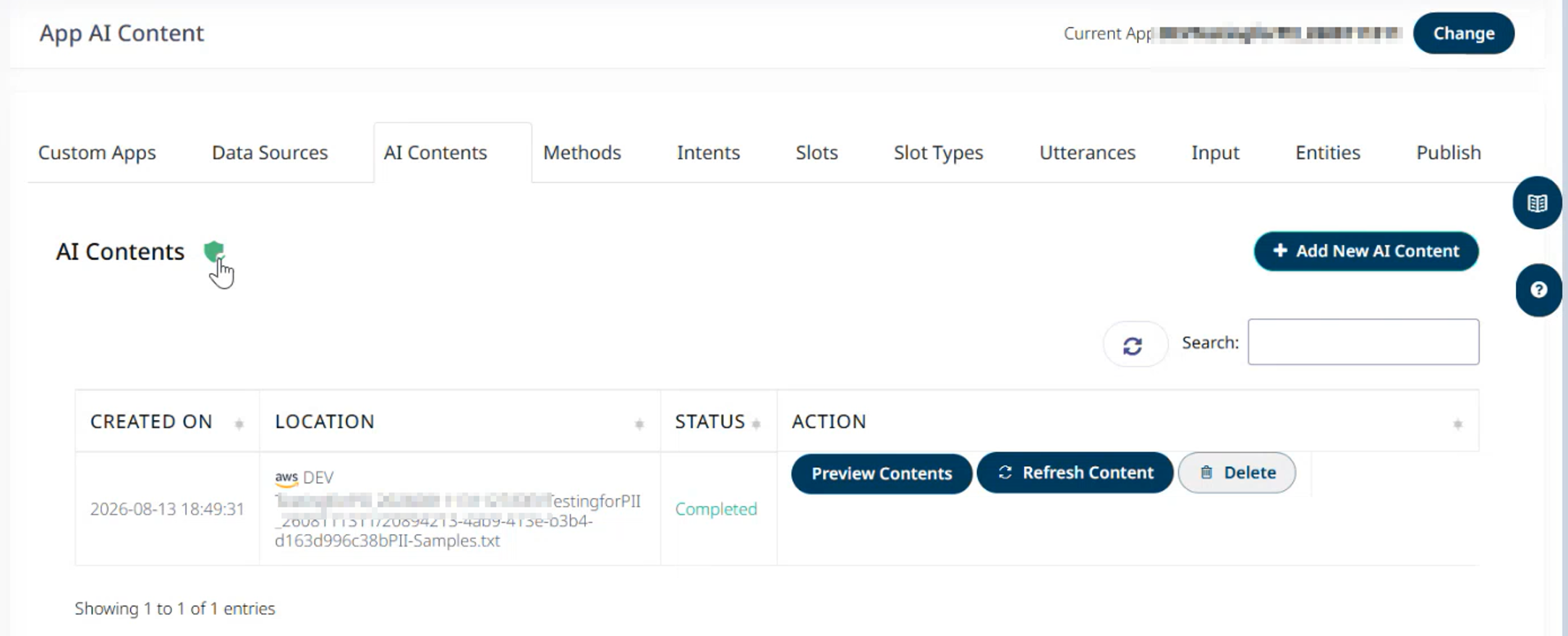
When documents are uploaded to the AI Content screen, the selected anonymization strategy is applied automatically. The protected content is then processed, indexed, and stored for retrieval.
This ensures that AI responses are generated using anonymized data rather than exposing original sensitive information.
***
### Supported Anonymization Strategies
The platform supports the following anonymization methods:
| Strategy | Description |
| ---------------------------------- | --------------------------------------------------------------------- |
| Replacement (Default) | Replaces sensitive information with redacted placeholders. |
| Masking | Hides sensitive data using masking characters such as asterisks (\*). |
| Encryption | Encrypts sensitive data before storage. |
| Format-Preserving Encryption (FPE) | Encrypts data while maintaining the original format and structure. |
| Hashing | Converts sensitive information into irreversible hash values. |
| Custom Scrambler | Rearranges characters or digits to obscure the original value. |
| Pseudonymization | Replaces sensitive values with realistic substitute values. |
{% hint style="info" %}
Note: If no strategy is selected, the system automatically applies the Replacement strategy.
{% endhint %}
***
### Where to Configure Anonymization Strategies
Anonymization strategies can be configured within:
* Basic Mode
* AI Content
* Publish Configuration
The selected strategy is applied during document processing.
***
### Applying an Anonymization Strategy
#### Steps
1. Navigate to the AI-Content screen.
Select the desired Anonymization Strategy out of 7 available strategies,
Click Save.
Upload the document.
Publish the content and test the bot.
Query the bot using information from the uploaded document.
The bot will return responses based on the anonymized version of the content.
***
### Example: Masking Strategy
#### Original Content
Plain Text1Name: John Smith2Phone Number: 9876543210Show more lines
#### Anonymized Content
Plain Text1Name: J\*\*\* S\*\*\*\*2Phone Number: \*\*\*\*\*\*3210
***
### Benefits
* Protects existing conversation history.
* Supports privacy and regulatory requirements.
* Eliminates manual redaction efforts.
* Provides automated scheduling options.
* Ensures historical data remains protected.
***
### Conclusion
The Anonymization Strategies feature provides a flexible and effective approach to protecting sensitive information throughout the AI knowledge ingestion and retrieval process. By offering multiple anonymization methods such as Replacement, Masking, Encryption, FPE, Hashing, Custom Scrambler, and Pseudonymization, organizations can choose the strategy that best aligns with their security, privacy, and compliance requirements.
When documents are uploaded, the selected strategy is automatically applied before content is processed, indexed, and stored. This ensures that sensitive information remains protected while still enabling users to leverage AI-powered search and conversational experiences.
By safeguarding data at the source, Anonymization Strategies help organizations enhance data privacy, reduce the risk of exposing confidential information, support regulatory compliance, and maintain trust in AI-driven interactions.
---
# Agent Instructions
This documentation is published with GitBook. GitBook is the documentation platform designed so that both humans and AI agents can read, navigate, and reason over technical content effectively. Learn more at gitbook.com.
## Querying This Documentation
If you need additional information that is not directly available in this page, you can query the documentation dynamically by asking a question.
Perform an HTTP GET request on the current page URL with the `ask` query parameter, and the optional `goal` query parameter:
```
GET https://docs.ixhello.com/ixhc/general/anonymization-strategies.md?ask=&goal=
```
`ask` is the immediate question: it should be specific, self-contained, and written in natural language.
`goal` is optional and describes the broader end goal you are ultimately trying to accomplish on behalf of the user. GitBook uses it to tailor the answer towards what is most useful for that goal.
The response will contain a direct answer to the question and relevant excerpts and sources from the documentation.
Use this mechanism when the answer is not explicitly present in the current page, you need clarification or additional context, or you want to retrieve related documentation sections.